All information on this site is provided by Mubite for educational purposes only, specifically related to financial market trading. It is not intended as an investment recommendation, business advice, investment opportunity analysis, or any form of general guidance on trading investment instruments. Trading in financial markets involves significant risk, and you should not invest more than you can afford to lose. Mubite does not offer any investment services as defined under the Capital Market Undertakings Act No. 256/2004 Coll. The content on this site is not directed toward residents in any country or jurisdiction where such information or use would violate local laws or regulations. Mubite is not a brokerage and does not accept deposits.
Mubite s.r.o., Školská 660/3, Nové Město, ICO: 23221551 Praha 1, 110 00, Czech Republic | Copyright Ⓒ 2026 Mubite. All Rights Reserved.
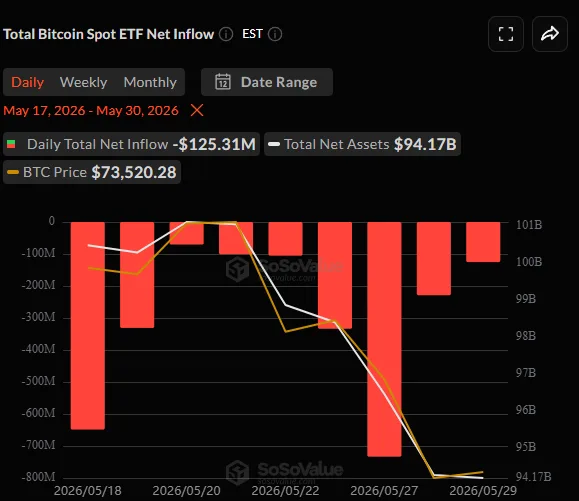
US spot Bitcoin ETFs have now recorded nine consecutive trading days of net outflows, the longest unbroken withdrawal streak since the funds launched in January 2024. Between May 15 and May 29, investors pulled approximately $2.8 billion from the 13-fund complex. BTC is trading at $73,105, down 11% from its May 6 high of $82,000. And buried in today's on-chain data: a Strategy wallet just moved 411.48 BTC worth $30.3 million onto Coinbase Prime, the platform institutions typically use when preparing to sell.
The streak began May 15 and has not broken since. The cumulative total of $2.8 billion surpasses every previous period of sustained ETF selling since the products launched.
The single most significant session was May 27. BlackRock's IBIT recorded $527.84 million in net outflows, its second-largest single-day redemption on record, missing its all-time high of $528.3 million by roughly $500,000. Fidelity's FBTC lost $60.30 million the same day. Grayscale's GBTC lost $104.76 million, pushing its cumulative outflows since conversion past $26 billion.
Key data points from the streak:
Total outflows May 15 to May 29: $2.8 billion
This week alone: $1.3 billion – three consecutive weeks of net outflows
IBIT cumulative outflows May 15 to May 28: $2.04 billion
BTC price decline over the same period: from $82,000 to $73,105
Total net assets across the 13-fund complex: dropped from $104B to $94.25B
One important clarification from the data: a $1.29 billion dark pool block trade of IBIT shares on May 26 made headlines but was not a net outflow. Dark pool trades are privately negotiated secondary market transactions that do not directly trigger ETF redemptions. IBIT's actual net outflow that day was $192.44 million. The math matters when reading these numbers.

Investors are not running from risk broadly. The S&P 500 hit record highs above 7,200 during May while Bitcoin slid roughly 5%. Investors are running from this particular flavour of it.
The macro explanation is specific. April CPI came in at 3.8%, the highest reading since May 2023, complicating the Fed's rate calculus. US-Iran military strikes added geopolitical pressure. Bitcoin, which has traded increasingly as a macro risk asset throughout 2026, repriced accordingly.
Previous periods of sustained ETF selling, particularly when viewed through Glassnode's 14-day moving average of flows, have often coincided with local Bitcoin bottoms. Glassnode's realised profit and loss ratio currently sits at 1.56, below the levels typical of stronger bull markets but not at the capitulation readings that have historically marked major lows.
Long-term holder supply has reached a record 15.8 million BTC according to CryptoQuant, normally a bullish signal because it reflects coins held rather than traded. The tension between that structural signal and the ETF outflow data is where the honest uncertainty sits.
The ETF outflow streak alone is significant. The Strategy wallet move makes it materially more concerning.
On-chain analytics firm Lookonchain flagged that a Strategy-linked wallet moved 411.48 BTC worth approximately $30.3 million to Coinbase Prime today. Strategy has not issued a statement. But the market has a strong prior: Coinbase Prime is the platform institutional sellers use to execute large OTC transactions.
Polymarket odds that Strategy sells BTC by June 30 sit at 74%. Odds of a sale by December 31, 2026 are at 91%.
Strategy has been one of the most consistent and significant buyers of Bitcoin since 2020. Its purchases have been treated by much of the market as a structural floor, a reliable source of demand that absorbs selling pressure at scale. If Strategy becomes a seller, even temporarily, that floor disappears. The psychological impact of Saylor selling would likely exceed the mechanical impact of the actual BTC volume moved.
Understanding how liquidation mechanics respond when a market's assumed floor buyer reverses direction is not a hypothetical exercise right now. The same dynamic shapes funding rates on perpetual markets in ways that compound quickly when sentiment shifts.
Similar outflow patterns emerged during the correction in early February 2025, when Bitcoin briefly fell toward $60,000, and again in November, when ETF outflows accelerated around Bitcoin's post-all-time-high correction. In both cases, the outflow streak eventually reversed and was followed by renewed inflows.
The $55.79 billion cumulative net inflow base remains intact. The institutional adoption thesis has not reversed. But the conditions that would trigger a reversal of the current outflow streak are the same conditions that are currently absent: a macro catalyst, a Fed pivot signal, or a resolution of the geopolitical pressure that has weighed on risk assets for six weeks.
Polymarket traders are assigning the highest probability to BTC closing May between $72,000 and $76,000. The monthly close is today.
Nine days of ETF outflows is the most sustained institutional selling Bitcoin has seen since ETFs launched. It is also, historically, the kind of setup that has preceded recoveries. Both things are true simultaneously.
What is not debatable is the current environment. Macro headwinds are real. The Iran situation is unresolved. And a Strategy wallet just moved Bitcoin to a selling platform with 74% odds the company follows through. Position size should reflect the uncertainty in the data, not the confidence in either the bull or bear narrative.
Share it with your community